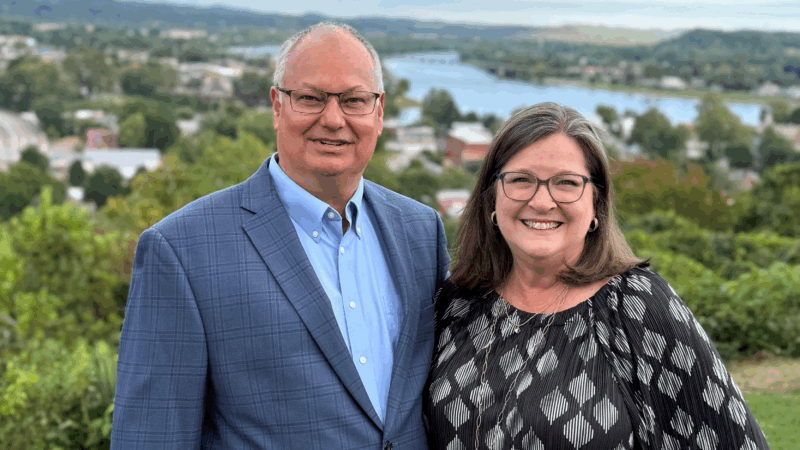
It was a shared desire to leave a legacy of positive impact – and a hope to inspire others to do the same – that led Karen Lines and Bill McElfresh to make a series of planned gifts that support their commitment to the small towns of Appalachian Ohio and the people who live here. They approached the Foundation for Appalachian Ohio with a plan designed to help ensure the continued vibrancy and quality of life in their rural communities.
Given Karen’s previous experience in finance and health care administration and Bill’s former work in program management and capital finance for the Ohio Department of Transportation, it’s no surprise the couple did their research before deciding how to structure their estate plan.
“We didn’t want to wing it,” Bill says. “So how do we break this down to make these plans effective, make them long term, make them focus on areas we enjoy but that will also help the communities.”
The result? A planned gift through the Foundation for Appalachian Ohio that will benefit the arts, the environment and career awareness/mentoring programs in Marietta, where the couple has lived for the last four decades, and in Bill’s native Morgan County. Specifically, their plan will support:

Twin City Opera House in McConnelsville, where Bill attended numerous shows as a youth

People’s Bank Theatre in Marietta, a local cultural gem in their adopted hometown

Tree planting in Morgan County and Marietta, inspired by Bill’s childhood memories of tree canopies in Chesterhill, Pennsville and Stockport and the welcoming feel of trees in their downtown Marietta neighborhood – and guided by recommendations from an urban forester with the Ohio Department of Natural Resources to make it more likely the new trees will survive

Building Bridges to Careers, a Washington County organization connecting students, businesses and community to help young people see the full range of career options available to them
That last piece was especially important to Karen, who worked full time to pay for her tuition and expenses while attending Marshall University in Huntington, W.Va. She recalls deciding to major in business because it maximized her chances for a career that would allow her to support herself easily. And while she says the decision has worked out well for her, she recognizes that many young people would thrive if they were aware of other opportunities.
“Not everyone has to go to college,” Karen says. “Building Bridges to Careers works with high school students, giving them internships and work exposure, which opens doors for them to move forward in lots of different ways. It gives these kids options, so they can see what all their career choices are.”
Ensuring that students have opportunities to pursue the education they need to live a good life is important to Karen and Bill, both first-generation college graduates. In addition to their planned gift through FAO, the couple has also supported emergency needs funds for students at Washington State College of Ohio for times when car troubles, day care expenses or grocery bills might jeopardize their ability to stay in school.
“Sometimes, even little bits of help would have made a difference,” Karen remembers.
When Karen and Bill began planning how they wanted to structure their estate plan, a discussion with Twin City Opera House Executive Director Adam Shriver, a longtime FAO partner, pointed them toward the regional community foundation as a resource. After learning more – the diversity and experiences of its board, its fee structure and its investment performance – they decided to work with FAO.
“With this organization, we found our comfort level that made it easy for us to really focus on what we wanted to do with our money instead of thinking about the mechanics of how it would work or feel like we had to write up so much detail to control it from the grave,” Karen says.
And now, through their planned gift, the couple knows their gift will help build and maintain small towns that people want to call home for years to come – communities with tree-lined streets, local theaters, pleasing aesthetics, homegrown businesses, and accessible educational and career opportunities.
“There is not a day that goes by where we don’t pinch ourselves that we retired when we wanted to, get to travel and have a great home to entertain friends for a good meal,” Bill says. “We think it’s a good choice to put the money to work for the future of the region.”