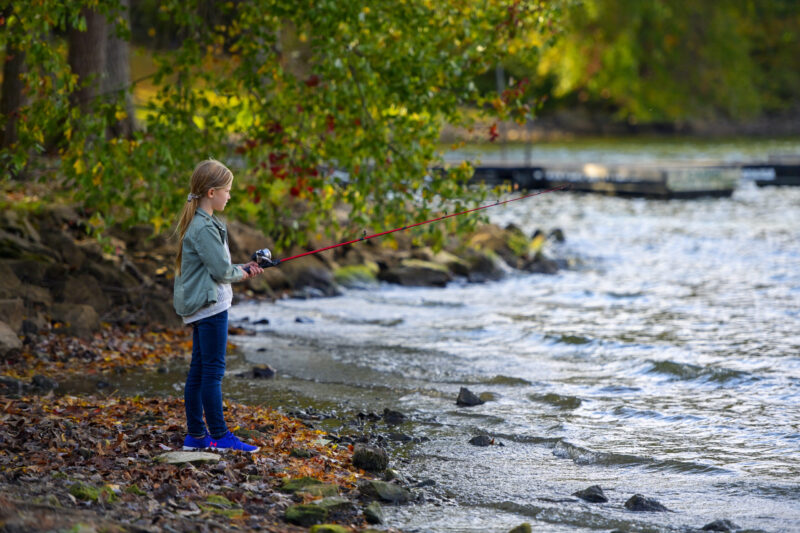
 Thanks to donor generosity and transformative partnerships, we are ensuring the people of Appalachian Ohio can experience our region’s natural beauty, both today and for generations to come. Donor support is strengthening parks, trails and outdoor recreational spaces; funding scholarships and fellowships focused on environmental stewardship; and providing opportunities for all to spend time in nature, cultivating future generations who will nurture our communities’ breathtaking landscapes.
2024 – 2025 Environmental Stewardship Impact Report
2023 – 2024 Environmental Stewardship Impact Report
Thanks to a transformative $5 million investment from the Muskingum Watershed Conservancy District (MWCD), in 2024 funding became available to support community projects, scholarships, fellowships, research and innovation in the areas of conservation and environmental stewardship.
In 2025, MWCD’s Board of Directors approved a $3 million gift to our Environmental Stewardship Pillar of Prosperity. That funding combined with gifts from other partners who helped establish our Environmental Stewardship Pillar of Prosperity Fund, including American Electric Power, the AEP Foundation, Nicolozakes Trucking & Construction Inc. and Ohio CAT, made the Environmental Stewardship Pillar the first pillar to reach $10 million. At that level, FAO will soon be able to award up to $500,000 in grants, fellowships and scholarships across the region. And because the fund is endowed, funding will be available every year.
Download the 2025 Environmental Stewardship RFP
Environmental Stewardship opportunities
To support locally driven projects that preserve and enhance our natural environment. Public and nonprofit organizations as well as individuals or groups working with a fiscal sponsor are eligible to apply. Applications for 2025 funding closed July 15.
To provide two years of support (including a financial stipend and mentorship) for individuals who pioneer positive change through projects that address environmental challenges and promote biodiversity conservation. Nominations for 2025 funding closed July 15.
To invest in new and creative approaches that result in environmental good while encouraging environmental stewardship. Applications for 2025 funding closed July 15.
To support studies that address critical gaps in our understanding of our diverse ecosystems and contribute to the conservation and enhancement of aquatic biodiversity and healthy habitats. Applications for 2025 funding closed July 15.
To support individuals seeking degrees or continuing education in ecology, forestry, wildlife ecology or related natural resource fields, as well as skilled trades, vocational and technical training in fields that integrate and support green energy technology, sustainable agriculture and land stewardship. Scholarships will be available as part of FAO’s annual scholarship application cycle, which will open in January 2026. Sign up for FAO’s e-newsletter to receive updates on this and other scholarship opportunities.
2025 Environmental Stewardship funding recipients
Five community grants will support locally driven projects that preserve and enhance the natural environment. Funding was awarded to:
- Base Camp Alpha to support a veteran-led project that will transform an underutilized area of the Jackson County veteran-founded sanctuary into a thriving native habitat and offer hands-on environmental engagement opportunities to the community
- Caldwell Exempted Village School District in Noble County to construct an outdoor classroom that will provide students with hands-on educational experiences centered around the importance of native pollinators, sustainable gardening practices and environmental stewardship
- Camp Wyandot in Hocking County to support a project that will engage campers and the local community in the restoration of degraded forest land using native species and sustainable management practices
- Children’s Advocacy Center of Guernsey County to restore and enhance the outdoor playground area, making it a trauma-informed, environmentally sustainable and community accessible healing space
- The Wilderness Center to support a project that will engage the community in the ecological restoration of a portion of the Middle Fork of Sugar Creek in Stark County’s Muskingum Watershed
Jill Moorhead, a trustee of the Buckeye Trail Association, was awarded a fellowship to support her work in building the association’s capacity to engage people in environmental stewardship across the region.
The Buckeye Trail Association maintains and promotes the more than 1,400-mile Buckeye Trail, much of which winds through Appalachian Ohio and the Muskingum Watershed region. Moorhead’s work includes leading the final phase of the association’s website refresh, developing communication tools and leading a workshop for volunteers and event planners in Appalachian counties – all with a goal of making the region’s environmental stewardship work visible, compelling and sustainable.
Warriors 2 Wilderness was awarded an innovation grant to support “Roots of Resilience,” a project that will empower veterans and the broader community through a series of outdoor activities, workshops and environmental stewardship initiatives.
The Muskingum County-based nonprofit provides immersive retreats, combining the serenity of nature, structured therapeutic activities and peer support, that promote mental health and wellness among veterans.
Five grants will support studies that address critical gaps in understanding our diverse ecosystems and contribute to the conservation and enhancement of aquatic biodiversity and healthy habitats. Funding was awarded to:
- Rural Action to study the water quality and bird habitat impacts of converting a woodlot to silvopasture, which is the managed integration of grazing livestock, trees and forages, on a farm research site in Lawrence County
- Steubenville City Schools to engage students in a research project to determine the presence of microplastics in the Jefferson County tributaries of the Ohio River
- University of Rio Grande to help complete the development of a 72-acre nature complex on the Gallia County campus by supporting riparian corridor restoration and native seeding of the floodplain meadow along Granny Creek and facilitating a public workshop on the planning, design and construction of vernal pools
- The Wilderness Center to implement a data-driven conservation prioritization framework across its operational area in Appalachian Ohio, allowing the nonprofit to systematically evaluate and prioritize land acquisition and management projects
- Youngstown State University to study the sediment dynamics and water clarity and quality variations across Tappan Lake in Harrison County and how these factors may contribute to the development of algal blooms
2024 Environmental Stewardship funding recipients
Five community grants, totaling $20,000, are supporting locally driven projects that preserve and enhance our natural environment. Funding was awarded to:
- The Big Love Network to distribute starter forests to residential and commercial properties in southeast Akron, which has the lowest tree canopy per capita within the greater Akron area.
- Briggs Lawrence County Public Library to support the development of a community garden on library property near the Proctorville branch.
- The Burchfield Homestead Society in Columbiana County to support the expansion of its garden arts programming, including updating the garden and maintenance equipment and implementing a series of pollinator garden-inspired arts workshops.
- The Dawes Arboretum to provide STEAM (science, technology, engineering, art and math) activity kits to underserved youth in Licking County and neighboring communities.
- Hubbard Friends of the Library to help renovate and enhance the Sensory Garden at the Hubbard Library, serving Columbiana, Mahoning and Trumbull counties.
Rebecca Eagle-Malone, PhD, an assistant professor of biology at Malone University, was awarded a fellowship to support her work to develop a week-long science camp for students at Carrollton Middle School in Carroll County.
Dubbed “Let’s Get Environmental,” the camp will provide students opportunities to assess sustainability measures, conduct biodiversity surveys, map trails and explore environmental-related careers in Appalachian Ohio during summers 2025 and 2026.
Two grants, totaling $16,000, are investing in new and creative approaches that result in environmental good while encouraging environmental stewardship. Funding was awarded to:
- The Alexander Inclusive Playground Project, serving Athens, Meigs and Vinton counties, to help integrate solar technology as part of the playground project to create environmental learning opportunities.
- The Southeast Ohio Recycling Terminal, serving Athens and Hocking counties, to conduct a feasibility study to assess options for biosolids disposal that could save municipalities money, create jobs and reduce greenhouse gas emissions at the Nelsonville landfill.
Seven grants, totaling $115,965, are supporting studies that address critical gaps in our understanding of our diverse ecosystems and contribute to the conservation and enhancement of aquatic biodiversity and healthy habitats. Funding was awarded to:
- Franciscan University of Steubenville to support habitat restoration, remediation, animal husbandry and ongoing environmental stewardship and educational outreach in portions of Cross Creek, Short Creek and Yellow Creek watersheds in Belmont, Columbiana, Harrison and Jefferson counties for the hellbender salamander, an endangered amphibian.
- The Holmes Soil and Water Conservation District for fecal source tracking tests and E. coli sampling on portions of the Doughty Creek water system to measure bacterial contamination, gain insight into the sources, educate the community and pinpoint bacteria-reduction solutions for the watershed.
- Ohio University to support a project that will study whether dredge material from Appalachian Ohio’s inland lakes, laden with excess nutrients that create conditions that exacerbate toxic algal blooms, is suitable for application on reclaimed coal mine lands.
- Rising Appalachia to develop and implement standardized metrics for assessing the impacts of land use practices on biodiversity, habitat health, and water and soil quality; to establish collaborative research partnerships with landowners, researchers and nonprofits to promote data-driven conservation and forest production practices; and to innovate and apply advanced methodologies for comprehensive ecosystem monitoring and restoration. Rising Appalachia serves Athens, Hocking, Meigs and Vinton counties.
- The Ohio State University to pilot a small terrestrial vertebrate monitoring system at Tappan Lake in Harrison County that will provide baseline species data, determine the suitability of the monitoring system in unglaciated habitats and demonstrate a workflow for efficient data analysis and sharing.
- Western Reserve Land Conservancy to support a 17-acre habitat restoration project at Ashcroft Woods Preserve in Ashtabula County, which will encourage breeding and recovery of the endangered Eastern Massasauga rattlesnake and facilitate research with other partners. The conservancy serves Ashland, Ashtabula, Carroll, Coshocton, Holmes, Jefferson, Mahoning, Richland, Stark, Summit, Trumbull, Tuscarawas and Wayne counties.
- Youngstown State University to support a project that is conducting monitoring and modeling in Tappan Lake in Harrison County and to develop scenario analysis for nutrient reduction – and potentially algal bloom reduction – in the lake.